

Maryland State Delegate Matt Morgan either didn’t read the DOE emergency order he’s tweeting about, or he’s counting on you not to.
The chair of the Maryland Freedom Caucus, Matt Morgan, posted to X on Sunday, January 25, that “Wind and solar energy appear to be falling short today,” citing a Department of Energy emergency order as proof.
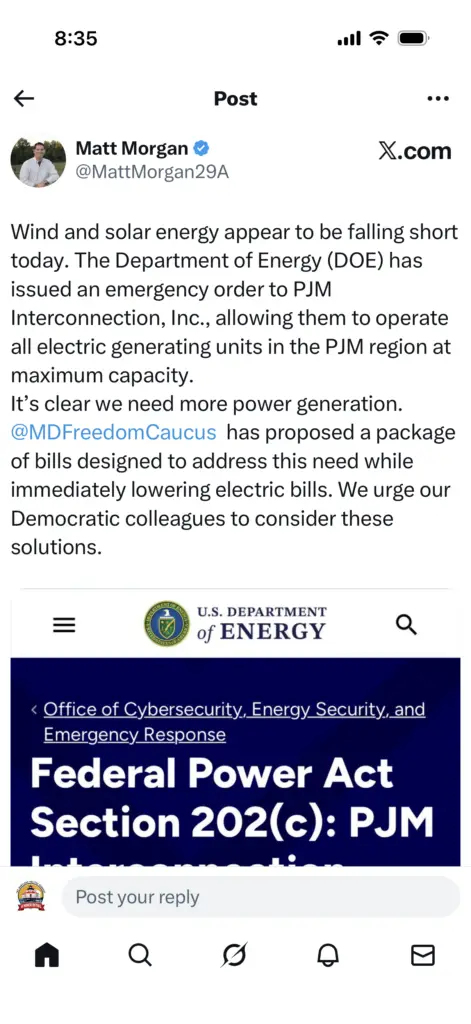
Mr. Morgan urged Maryland Democrats to embrace the “Freedom Caucus energy package.”
There’s just one problem: The order Delegate Morgan cited does the opposite of what he claims. The order suspends emissions limits on fossil-fuel plants, but not on wind turbines or solar panels – because they don’t have smokestacks.
The order allows PJM to run all electric generating units located within the PJM Region and to operate up to their maximum generation output levels, notwithstanding air quality or other permit limitations. American Public Power Association.
In other words, the DOE’s emergency order issued for PJM Interconnection during Winter Storm Fern specifically waives environmental regulations to allow power plants to operate at maximum capacity even if they violate air quality permits.
By definition, this applies to fossil-fuel generation (coal, gas, oil), which produces emissions regulated by the EPA (sulfur dioxide, nitrogen oxides, mercury). Wind and solar energy sources do not produce emissions and therefore do not require “air quality” permits to be suspended.
That’s not an indictment of renewables; it’s permission for coal and gas plants to exceed their pollution permits.
Maryland’s Freedom Caucus waved around a document on fossil fuel emissions limits, pretending it said something about wind and solar (when it didn’t).
Quick Reference: What the DOE’s Emergency Order Actually Does & Doesn’t Do
-
What the Order Does: It legally protects fossil fuel plants from being fined or shut down for polluting too much during the emergency.
-
Why It Doesn’t Apply to Renewables: Wind turbines and solar panels do not have smokestacks or emissions permits. Suspending “air quality limits” for a solar farm is a regulatory impossibility.
The Department of Energy (DOE) order issued for PJM in January 2026 (Order No. 202-26-2) explicitly invokes Section 202(c) of the Federal Power Act to waive compliance with environmental regulations.
The text states PJM may operate units “notwithstanding air quality or other permit limitations,” specifically citing sulfur dioxide, nitrogen oxide, and mercury – pollutants associated exclusively with thermal generation (coal, gas, oil).
Wind and solar facilities do not emit the criteria pollutants (SO2, NOx, Mercury) regulated under Clean Air Act permits, and permits are being waived.
They do not have “emissions permits” to suspend.
Here’s what Mr. Morgan seemingly doesn’t understand: The DOE emergency order is a regulatory tool to unleash fossil fuel capacity, not a “repair order” for broken wind or solar farms.
Delegate Matt Morgan Isn’t Telling the Truth in his January 25 X Post
Delegate Matt Morgan – a Donald Trump MAGA loyalist – claims fall apart the moment you ask a fundamental question: If wind and solar are “falling short,” why does the emergency order suspend emissions permits?
Wind turbines do not have emissions permits. Solar panels do not have air quality restrictions to waive.
The DOE is not giving renewable energy a hall pass here – it’s telling fossil fuel plants they can run dirtier than usually allowed (during a regional winter storm).
What’s Actually Happening With the Power Grid in the Region
During Winter Storm Fern, gas met more than 39 percent of PJM’s load, nuclear supplied 26 percent, coal nearly 23 percent, and wind fed just shy of 5 percent.
Wind is producing roughly what grid planners expected.
Solar – in January, during a snowstorm – was never expected to carry the load.
Therefore, neither is “falling short,” as Mr. Morgan falsely claims. They’re performing within the parameters every serious grid analyst understands.
What’s the actual strain?
Grid operators said peak power demand could exceed 130,000 megawatts for seven straight days after the winter storm hits, an extreme scenario PJM has never experienced.
That’s a demand problem – driven by extreme cold; it’s not a renewable energy problem.
The Maryland Freedom Caucus’s Convenient Amnesia About Fossil Fuel Failures
Here’s what the Freedom Caucus conveniently fails to mention: When regional winter storms actually cause generator failures, it’s overwhelmingly the “reliable” fossil fuel plants that collapse.
During Winter Storm Elliott in December 2022 – the last comparable event in PJM territory – gas generators were responsible for 70 percent of forced outages.
That’s not a typo: Seventy percent.
Natural gas, the fuel source the Freedom Caucus treats as the answer to all reliability concerns, failed catastrophically when temperatures dropped.
Meanwhile, during that same storm, wind and solar resources performed as the near-term forecasts projected.
The Freedom Caucus wants to keep coal plants open and roll back renewable energy investment, all the while ignoring the documented reality that gas plants are the ones that freeze up and fail when Marylanders need heat most.
The Real Grid Crisis That The Maryland Freedom Caucus Ignores
PJM has been explicit about what’s actually threatening grid reliability – and it’s not wind turbines.
It’s this: Electricity demand is growing at the fastest pace in years, primarily driven by the proliferation of data centers.
Data centers are massive server farms gobbling up electricity in Northern Virginia and increasingly across Maryland; they are driving demand growth that’s outpacing every projection.
“This auction leaves no doubt that data centers’ demand for electricity continues to outstrip new supply far.”
But the Freedom Caucus energy package doesn’t address data center demand.
And their plan does not propose expedited permitting for new generation, nor does it tackle interconnection queue backlogs that delay new power plants for years.
What is the Maryland Freedom Caucus’s Four-Point Energy Reduction Plan?
- Repeal the Climate Solutions Act,
- Stop Maryland Governor Wes Moore’s $180 million in alternative-energy investments.
- Keep coal plants open.
- EmPOWER Maryland.
The Freedom Caucus’s “plan” is not an authentic energy policy proposal; it’s a press release in legislative format.
What the Maryland Freedom Caucus Is Actually Good At
Let’s give the Maryland Freedom Caucus the credit it deserves:
- They’re excellent at holding hearings.
- They’ve convened multi-state panels.
- They’ve invited PJM representatives to Annapolis.
- They’ve staged press conferences with out-of-state legislators.
What the Maryland Freedom Caucus has categorically failed to deliver is virtually any serious statewide public policy solutions to address the supply-demand crisis PJM has documented.
The Maryland Freedom Caucus’s apparent solution to a grid straining under data center demand and thermal plant retirements is to keep the coal plants open a little longer and hope for the best.
We agree: the Maryland Freedom Caucus isn’t a serious legislative caucus.
The Freedom Caucus members are experts in political performance art for constituents who want someone or something to blame for their electric bills.
Despite sitting in the shadow of regional world-class academic institutions, the Freedom Caucus seems allergic to rigorous research.
And when a winter storm hands them a federal emergency order they clearly didn’t read, they’ll publish it to X and hope nobody checks their work.
Matt Morgan Spends His Energy Wasting Maryland Taxpayers’ Time
Maryland State Delegate Matt Morgan, during a major regional winter storm, rushed to X to post a document on fossil fuel emissions limits, claiming it proves wind and solar are failing.
Either Mr. Morgan didn’t read past the headline (likely), or he’s betting his followers won’t (also likely).
The actual evidence – from PJM’s own reports, from federal regulators, from the documented history of winter storm failures – shows that gas plants are the reliability risk during cold snaps, that demand growth from data centers is the structural threat to grid stability, and that the Freedom Caucus energy package addresses none of it.
But hey, at least the Maryland Freedom Caucus got some engagement on X, their favorite way to waste Maryland taxpayers’ time.